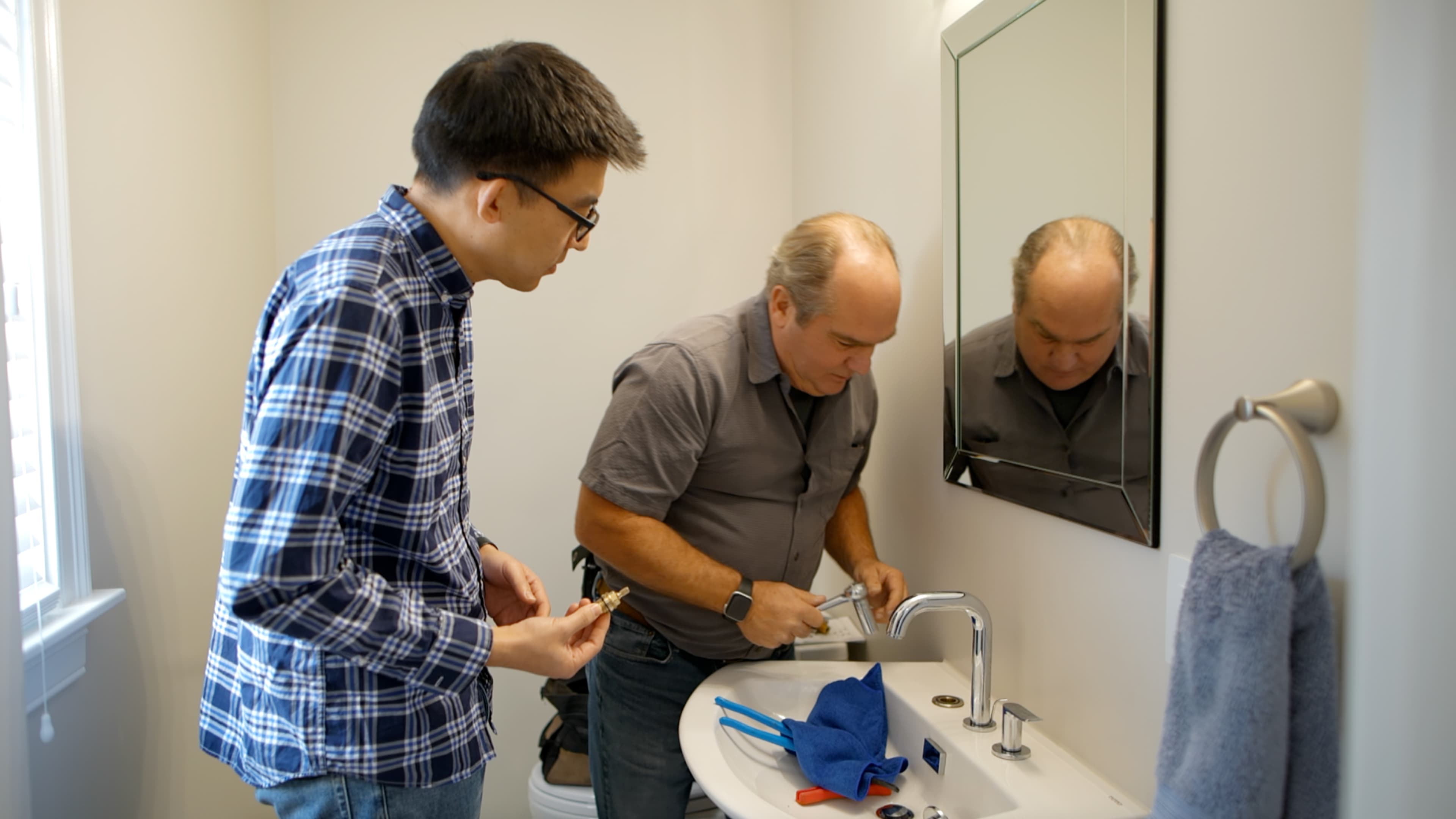
A faucet handle that sticks, grinds, or just won’t budge is frustrating—especially when your hands are dirty, and all you want to do is wash them. But a sticky faucet handle doesn’t necessarily mean you need a whole new faucet. With some troubleshooting and basic tools, you can swap out the problem part without an expensive service call.
Common Stuck Faucet Causes
In most cases, the issue will be the faucet cartridge, which sits inside the faucet, under the handle. But there are a few reasons why the cartridge can become difficult to operate:
- Mineral buildup: Hard water can leave mineral deposits that jam up the moving parts in a faucet cartridge, making it hard to twist.
- Corrosion: Metal parts inside older faucets can corrode and freeze in place.
- Worn seals: O-ring and other seals inside faucet cartridges can break down, bind, or swell.
- Overtightening: If the cartridge was overtightened at the factory or during installation, it can be hard to operate.
- Sediment accumulation: Beyond minerals, other debris in the water can collect and jam moving parts.
In most of these cases, you’ll need to clean or replace the cartridge. Fortunately, cartridge replacement is straightforward and typically costs far less than replacing the entire faucet.
How to Fix a Stuck Faucet Handle
You will need:
- Screwdriver
- Allen wrench (for set screw)
- Water pump pliers
- Socket set
- Faucet cartridge
- First, try to identify that faucet type. If you can’t find a name and serial number on the faucet, take a picture of it and use an identification app to find the part number. If that doesn’t work, take the picture to the parts supply house. An experienced parts person can help find the cartridge and order a replacement if there isn’t one in stock.
- Shut the water off at the wall, either behind the sink or in the cabinet below it. Despite only one handle sticking, shut off both the hot and cold water. If one supply line is still charged, water can spray into the air if the faucet is accidentally turned when the cartridge is loose. Open the faucet to drain remaining water and release pressure.
- Remove the handle. There is often a set screw at the base of the handle, or a screw through the top of the handle. In some cases, the handle might have a screw-on base holding it to the sink. Loosen the base.
- Before removing the cartridge, remove any U-shaped retaining clip or threaded retaining nut that may be holding the cartridge in place.
- With the water off, find the proper size socket to fit down inside the faucet body and over the cartridge. Use the socket wrench to loosen and remove the cartridge. Avoid excessive force; instead wiggle gently while pulling upward.
- Place the new cartridge inside the faucet and carefully use the socket to start tightening the cartridge. Be careful not to cross-thread it during installation. Once threaded, just snug it in place. Don’t overtighten.
- Place the handle back on the cartridge and tighten it in place. Do not use Teflon tape or pipe dope unless the manufacturer suggests it.
- Turn the water back on and check to ensure the handle is now working properly and check for leaks.